
On April 13, 2026, Energy and Environment Consultancy Joint Stock Company (VNEEC), in collaboration with the Department of Legal Affairs (Ministry of Finance) and the Southeast Asia Energy Transition Partnership (ETP), United Nations Office for Project Services (UNOPS), organized the “Capacity-building training on policies and legal regulations for developing the domestic carbon market”.
The event was held under the framework of the technical assistance project: “Vietnam Carbon Trade Exchange – Pilot Scheme Preparation with MOF, Phase 2”. Its primary goal is to support Ministry of Finance officials in implementing the domestic carbon trading platform during the 2025-2028 pilot phase.
The training focused on updating and disseminating legal regulations regarding tradable assets and the market development roadmap. Key topics included an overview of the legal framework and models for the domestic carbon exchange, the trading system at the Hanoi Stock Exchange, and international experiences regarding emission trading systems (ETS). The training course was highly successful, attracting the interest and participation of over 150 delegates, including representatives from regulatory agencies, research institutions, businesses, as well as domestic and international experts.
 Photo: Ms. Vu Thi Chau Quynh – Deputy Director General of the Department of Legal Affairs, Ministry of Finance
In her opening remarks, Ms. Vu Thi Chau Quynh – Deputy Director General of the Department of Legal Affairs, Ministry of Finance emphasized that amidst the increasing complexity of climate change, Vietnam has proactively engaged in international commitments such as the United Nations Framework Convention on Climate Change (UNFCCC), the Kyoto Protocol, and the Paris Agreement. Furthermore, Vietnam set a target to achieve “Net Zero” emissions by 2050 at the COP26 Summit. In parallel, the Government has been implementing decisive adaptation policies, with a core focus on integrating economic development with climate change response for the 2026-2030 period.
Representing UNOPS, Mr. John Robert Cotton – Senior Program Manager, ETP highly commended the leadership and close coordination of the Ministry of Finance throughout the project’s implementation. He affirmed that developing a carbon market is not only a national mandate but also a significant contribution to global climate change mitigation efforts. On behalf of ETP, he committed to continued partnership with the Ministry of Finance in building a synchronized operating system for the carbon credit exchange, ensuring it stays on schedule from the very first pilot phase.
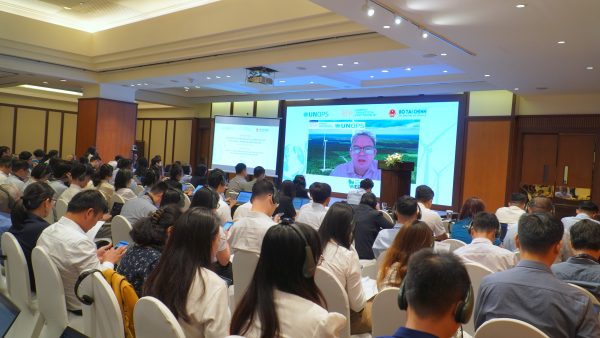 Photo: Mr. John Robert Cotton – Senior Program Manager of ETP, UNOPS
Presenting on tradable assets and the market development roadmap, Mr. Pham Nam Hung – representative of the Carbon Market Division, Department of Climate Change, Ministry of Agriculture and Environment shared that the market will focus on trading emission quotas and carbon credits. Specifically, 110 major facilities in the thermal power, steel, and cement sectors have been allocated over 500 million tons of quotas. Notably, Vietnam allows businesses to use carbon credits to offset up to 30% of their excess emissions and is expanding international exchange mechanisms under Decree No. 112/2026/ND-CP. This creates flexibility and encourages enterprises to proactively innovate technology to adapt to the trend of tightening quotas in the future.
 Photo: Mr. Pham Nam Hung – representative of the Carbon Market Division, Department of Climate Change, Ministry of Agriculture and Environment
In addition, Mr. Do Thanh Lam – representative of the Department of Legal Affairs, Ministry of Finance shared an overview of the legal framework for the carbon exchange, centering on Decree No. 29/2026/ND-CP and related regulations. The exchange will be established on the existing infrastructure of the stock market. Specifically, the Hanoi Stock Exchange will organize the trading activities, while the Vietnam Securities Depository and Clearing Corporation (VSDC) will handle depository and settlement functions. Key participants include enterprises trading quotas, carbon credit investors, and intermediaries such as securities companies.
 Photo: Mr. Do Thanh Lam – representative of the Department of Legal Affairs, Ministry of Finance
According to Ms. Nguyen Thi Thu Ha – Director of the Derivatives Market Department, Hanoi Stock Exchange, to participate in the exchange, enterprises are required to have a tax identification number and complete registration on the National Registry System. By leveraging existing securities infrastructure, entities can use their current securities accounts for trading based on the principle of having sufficient funds when placing buy orders and sufficient assets (quotas/credits) when placing sell orders. Ms. Ha also affirmed that although sharing the same technological platform, the carbon market and the stock market will be managed separately to ensure maximum specialization and transparency for all participants.
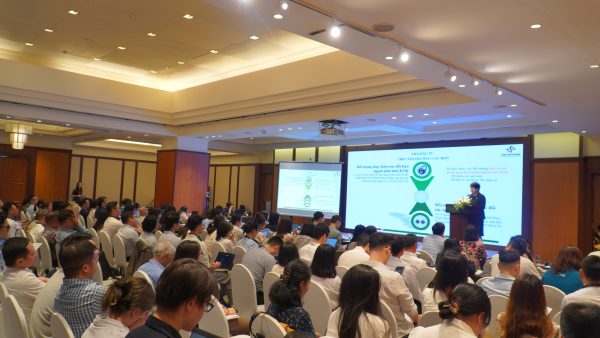 Photo: Ms. Nguyen Thi Thu Ha – Director of the Derivatives Market Department, Hanoi Stock Exchange
Notably, Ms. Dang Hong Hanh – Lead Consultant, Co-founder and Director of VNEEC, presented a detailed roadmap for enterprises entering the carbon market. She emphasized the pivotal role of the Measurement, Reporting, and Verification (MRV) system, along with account establishment on the national registry, as prerequisites for market operation. Ms. Hanh recommended that businesses undergo a significant mindset shift: rather than viewing quota compliance merely as an administrative obligation, they should perceive carbon quotas and credits as genuine financial assets. Optimizing these assets through emission reduction strategies and technological investments will not only help enterprises reduce compliance costs but also unlock opportunities for profit through exchange trading.
 Photo: Ms. Dang Hong Hanh – Lead Consultant, Co-founder and Director of VNEEC
In addition to the latest legal frameworks, the training course expanded on international perspectives through practical lessons on market stability tools, monitoring mechanisms, and risk management on exchanges from pioneering carbon markets in the European Union, the United Kingdom and China.
During the closing discussion session, delegates exchanged views on practical challenges in implementing the carbon exchange, particularly regarding corporate readiness, the synchronization of market infrastructure, and inter-sectoral coordination mechanisms among regulatory authorities.

The training course serves as a practical activity contributing to capacity building for both regulatory bodies and market participants, while creating a solid foundation to promote the pilot operation of Vietnam’s carbon credit exchange in the coming period. As a technical consultant, VNEEC will continue to accompany stakeholders and businesses in identifying challenges, as well as researching and proposing solutions, towards the national goal of Net Zero emissions.
1,927 views, 2
Tags:
Bài viết liên quan