May 21, 2026 — The Government issued Decree No. 180/2026/ND-CP on forest carbon sequestration and storage services. This is the first comprehensive legal document governing the development, verification, trading, and benefit-sharing of forest carbon credits in Viet Nam.
After years of waiting, the core issues that had been the market’s biggest barriers, credit ownership, eligible project developers, trading conditions, and benefit-sharing mechanisms, have now been specifically regulated.
1. Forest carbon credit ownership is clearly established
One of the biggest questions in the market for many years has been: “Who owns the carbon credits generated from forests?” Decree No. 180/2026/ND-CP, for the first time, introduces a mechanism to clearly determine ownership of forest mitigation outcomes and carbon credits.
Clause 4, Article 3 provides that, for state-owned forests, the representative of the owner of forest mitigation outcomes and carbon credits is determined based on the entity implementing the project:
- The Ministry of Agriculture and Environment acts as the representative owner for projects implemented by specialized agencies under the Ministry.
- Provincial People’s Committees act as the representative owners for projects implemented by provincial specialized agencies.
- Forest owners own the forest mitigation outcomes and carbon credits generated from projects implemented by the forest owners themselves.
Clear ownership determination is a prerequisite for forest carbon credits to be legally registered, traded, and transferred on the market.
2. Forest owners officially granted the right to develop carbon projects
For the first time, forest owners, including organizations, households, individuals, and residential communities, are officially empowered to register and implement forest carbon projects, with flexible arrangements such as self-implementation, cooperation, linkage, or delegation to another organization. This provides an important legal basis for forest owners to proactively participate in the carbon credit market.
Article 8 of the Decree specifies the entities eligible to develop projects according to each forest ownership type, as follows:
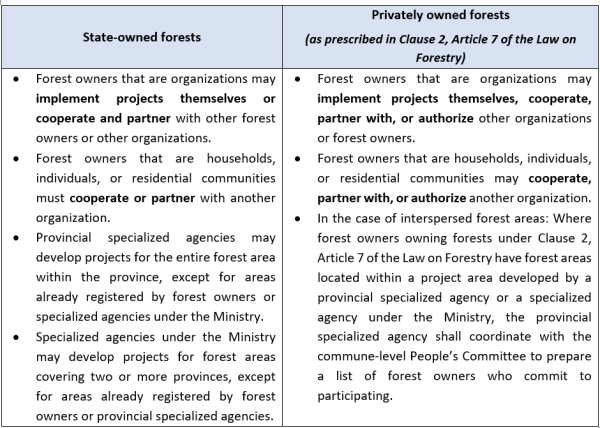
This opens up opportunities to mobilize broader social resources for forest carbon market development, rather than relying solely on national-level programs and agreements as before.
3. Forest carbon credits may only be traded after prior verification
Under Point d, Clause 1, Article 5, in conjunction with Clause 3, Article 10, the service provider may only exchange or transfer forest mitigation outcomes and carbon credits after they have been confirmed by the Ministry of Agriculture and Environment. This is an important principle for market control, helping to prevent double-selling or the sale of unverified credits.
Clause 3, Article 3 also provides that credits already exchanged or transferred under a contract or on a trading platform may not be exchanged or transferred to another party.
This is a requirement that project owners should pay particular attention to in order to ensure that forest carbon credits are eligible for market participation and transactions.
4. Floor price mechanism lays the market foundation
Article 7 regulates payment levels and pricing:
- The Minister of Agriculture and Environment sets the method for determining payment levels for forests under state-owned forests, denominated in VND per tonne of CO₂ or per forest carbon credit (guidance not yet issued)
- Domestic transaction prices are in VND; international transfers are in foreign currency per foreign exchange regulations
- The first-transaction price may not fall below the Ministry-determined floor — applicable to both domestic and international transactions
- Private forest owners are encouraged (not required) to apply the above pricing methodology
It should be noted that Article 7 only sets out the pricing framework and pricing methodology. The specific procedures, conditions, and processes for international transactions are governed by Decree No. 112/2026/ND-CP on the international exchange of forest mitigation outcomes and carbon credits
5. Clear benefit-sharing mechanism to incentivize project development
One of the issues of greatest interest to forest owners and investors is the mechanism for managing and sharing revenues from forest carbon credits. Decree No. 180/2026/ND-CP establishes two payment mechanisms corresponding to the entities participating in transactions, thereby ensuring transparency and suitability for different project development models.
Direct payment: This applies where forest owners or authorized organizations directly enter into contracts. The service provider has full discretion over the use of the proceeds after fulfilling tax, fee, and charge obligations. For service providers that are organizations, the remaining amount, after deducting costs for project development and implementation, payments to contracted forest protection parties, and support for buffer-zone communities, if any, shall be treated as the organization’s revenue and managed in accordance with the financial regulations applicable to that type of organization.
Indirect payment through the Vietnam Forest Protection and Development Fund (VNFF): This applies where contracts are signed by the Ministry of Agriculture and Environment or by provincial People’s Committees. The flow of funds is organized as follows:
- At VNFF: After deducting management costs and up to 3% of the total actual revenue to support measurement, reporting, and verification (MRV) activities, project development, forestry databases, and State activities for which sufficient funding has not yet been allocated, the remaining amount is transferred to the provincial Fund.
- At the provincial Fund: After deducting management costs, the remaining amount is paid to eligible beneficiaries.
It can be seen that Decree No. 180/2026/ND-CP establishes a relatively flexible financial mechanism, which both enables forest owners and project developers to proactively capture the economic value of carbon credits and ensures resources for management, monitoring, and benefit-sharing in large-scale programmes coordinated by the State.
6. Major opportunity, but readiness conditions required
Overall, Decree No. 180/2026/ND-CP marks an important step in completing the legal framework for the forest carbon credit market in Viet Nam. However, the successful development of a forest carbon credit project requires in-depth technical and governance capacity, including feasibility assessment and project design in accordance with the applicable carbon standard, development of the emissions baseline, establishment of MRV system, assurance of community consultation and environmental and social requirements, as well as continued implementation and monitoring of the carbon project throughout the commitment period.
For further advice on legal, technical, and governance matters related to forest carbon credits and market participation opportunities, please contact Energy and Environment Consultancy Joint Stock Company (VNEEC):
Energy And Environment Consultancy Joint Stock Company (VNEEC)
Office address: 8th Floor, Diamond Flower Tower, 48 Le Van Luong, Yen Hoa Ward, Hanoi
Hotline: +84 886675609
Email: eec@eec.vn – Website: eec.vn
4,360 views, 26
Tags:
Bài viết liên quan