The international carbon market is entering a new era of growth as nations accelerate their commitments toward Net Zero emissions. Against this backdrop, Article 6 of the Paris Agreement has emerged as a crucial framework for cooperation, while introducing stricter requirements regarding environmental integrity, transparency, and the prevention of double counting emission reduction outcomes.
To establish a solid legal foundation for participating in the international carbon market under Article 6, the Government issued Decree No. 112/2026/ND-CP on international transfer of greenhouse gas emission mitigation outcomes and carbon credits. The Decree outlines the core principles, eligibility criteria, and procedures for international transfers, while safeguarding national interests and ensuring alignment with Vietnam’s Nationally Determined Contributions (NDC). Providing technical assistance to the Southeast Asia Energy Transition Partnership (ETP, UNOPS), Energy and Environment Consultancy Joint Stock Company (VNEEC) actively contributed to research and recommendations aimed at refining the implementation mechanism for Article 6 in Vietnam.
Coupled with the official launch of the domestic carbon exchange on June 29, 2026, Vietnam has firmly transitioned into the execution phase. This mandates that businesses proactively map out their compliance strategies today.
1. Project readiness for credit generation and trading
While Decree No. 112 broadens the scope of eligible projects for international transfer, not all project types possess the same level of readiness. Based on their capability to generate tradable carbon credits, projects can be classified into the following tiers:
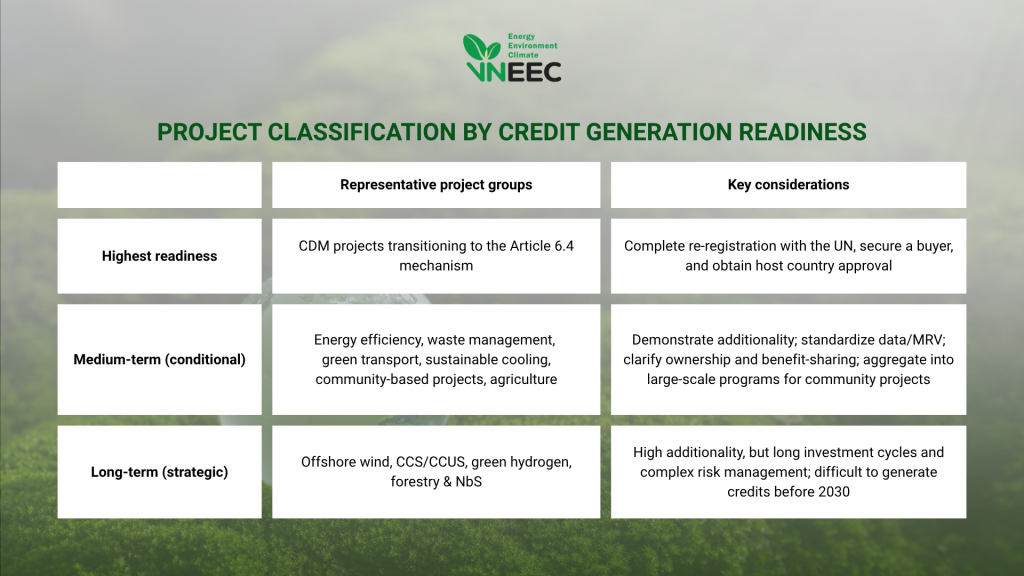 Table: Project classification by credit generation readiness
Highest readiness tier
CDM projects transitioning to the Article 6.4 mechanism are assessed to have the highest level of readiness. Benefiting from operational history, established monitoring data, and comprehensive technical documentation, this group can proceed to international transactions as soon as they complete re-registration with the UN body, secure a buyer, and receive host country approval. To date, out of 23 CDM projects in Vietnam registered for transition to Article 6.4, VNEEC has successfully advised and supported 15 renewable energy projects.
Medium-term tier
Projects focused on energy efficiency, technology transition, and green transportation hold significant potential due to their clear emission reductions and tangible economic benefits for businesses. However, this strong financial viability makes proving additionality a major hurdle.
For waste management, sustainable cooling, agriculture, and community-based projects, the main challenges revolve around establishing a stable operational data system, clarifying ownership of emission reduction outcomes, and managing MRV costs, particularly when deployed on a decentralized scale.
Long-term tier
Offshore wind, CCS/CCUS, and green hydrogen projects possess a clear advantage in demonstrating additionality due to high capital requirements and modest financial returns without carbon credit revenue. However, long development lifecycles and complex infrastructure demands make credit generation prior to 2030 unlikely.
For forestry and Nature-based Solutions (NbS) projects, the challenge lies not in carbon sequestration potential, but in governance. Land use rights, the permanence of sequestered carbon, reversal risks, and the quality of monitoring data will directly determine both the value and tradability of the credits generated.
2. Key determinants of carbon credit generation under Article 6
In practice, out of the 175 registered CDM programs and projects in Vietnam, only 44 met the eligibility criteria for transitioning to Article 6.4, and just 23 completed their submission applications. This reflects that credit generation capability depends not only on emission reduction potential, but also on the project’s level of readiness right from the initial phase.
To successfully develop an Article 6 project, businesses should pay special attention to the following factors:
Additionality
Projects risk disqualification if they already exhibit high financial returns, employ widespread technologies, or belong to mandatory compliance categories. Therefore, businesses must assess additionality during the pre-investment phase and select the appropriate methodology.
Data and MRV systems
Data serves as the foundation for quantifying emission reductions and issuing carbon credits. A lack of continuous, consistent data, or failure to meet methodological standards, will directly impact verification outcomes. Businesses need to establish a robust MRV system right from project inception.
Financial viability and operational performance
Carbon credit revenue does not always meet expectations. Actual credit yield can be influenced by equipment performance, operational capacity, feedstock availability, and data quality. When drafting financial plans, businesses must fully account for costs related to registration, MRV, verification, and project management.
Ownership and benefit-sharing mechanisms
For multi-stakeholder projects, ownership rights over emission reduction outcomes and benefit-sharing mechanisms must be clearly defined from the outset. This is a critical prerequisite for securing financing, registering the project, and negotiating with credit buyers.
Legal requirements for international transfer
Under Decree No. 112/2026/ND-CP, emission reduction outcomes can only be transferred internationally once all Article 6 requirements are fully met, official approval from the competent authority is obtained, and corresponding adjustments are applied.
Furthermore, depending on the activity category, the proportion of emission reduction outcomes permitted for international transfer may be capped at 90% or 50%, with the remaining portion retained to contribute toward the national NDC goals. Businesses must factor these limitations into their financial models and carbon revenue projections.
VNEEC partners with businesses throughout the Article 6 carbon credit project lifecycle, from legal and methodological advisory, to MRV setup, application finalization, and international transfer. Please contact Energy and Environment Consultancy Joint Stock Company (VNEEC) for expert support.
Energy and Environment Consultancy Joint Stock Company
Office address: Floor 8, Diamond Flower Tower, 48 Le Van Luong, Yen Hoa, Hanoi
Hotline: +84 886675609
Email: eec@eec.vn – Website: eec.vn
1,339 views, 13
Tags:
Bài viết liên quan