
On 9 February 2026, Deputy Prime Minister Tran Hong Ha signed Decision No. 263/QD-TTg approving the total greenhouse gas (GHG) emissions cap for the 2025–2026 pilot phase. Accordingly, the total pilot emissions cap is set at 243,082,392 tCO₂e for 2025 and 268,391,454 tCO₂e for 2026.
The Ministry of Agriculture and Environment serves as the lead agency, in coordination with the Ministry of Industry and Trade and the Ministry of Construction, to organize the pilot allocation of GHG emissions allowance to individual facilities in the thermal power, iron and steel production, and cement production sectors for the 2025–2026 pilot phase. In addition, the Ministry of Agriculture and Environment is also responsible for providing implementation guidance, conducting assessment and review of the pilot phase, and proposing improvements to relevant legal regulations on GHG inventory and GHG emissions allowance allocation. The Ministry of Industry and Trade and the Ministry of Construction are responsible for monitoring and evaluating facilities’ compliance with their allocated emissions allowances within their respective sectors.
The total GHG emissions allowances will be allocated by the Ministry of Agriculture and Environment to 110 facilities, including 34 thermal power plants, 25 iron and steel production facilities (crude steel production), and 51 cement production facilities (clinker production). Facilities eligible for allocation during the 2025–2026 pilot phase must be listed in the Annex to Decision No. 13/2024/QD-TTg of the Prime Minister promulgating the updated list of sectors and facilities required to conduct GHG inventories, and must have been in commercial operation for at least three years (i.e., operating before 1 January 2022).
Emissions allowances will be allocated at no cost during the 2025–2026 pilot phase. The methodology for allocating GHG emissions allowances to facilities complies with Appendix I of Government Decree No. 119/2025/ND-CP, which amends and supplements a number of articles of Decree No. 06/2022/ND-CP dated 7 January 2022 on GHG emission mitigation and ozone layer protection. GHG emissions allowances are determined based on the following factors: GHG emissions intensity per unit of product; sectoral growth targets; GHG emission reduction targets of the sector and of individual facilities in line with their production and business plans; the mitigation potential of each facility; and the technical, technological, and financial capacity of the facility to implement GHG mitigation measures. In particular, the average GHG emissions intensity per unit of product is determined on the basis of GHG emissions per unit of output, specifically: kWh of electricity for thermal power plants; tonnes of crude steel for iron and steel production facilities; and tonnes of clinker for cement production facilities.
In particular, GHG emissions intensity per unit of product is determined separately for each technology type within each sector. In the thermal power sector, four technology groups are distinguished: coal-fired power, oil-fired power, gas-fired power, and co-firing. The iron and steel sector is also divided into four technology groups: BF-BOF, EAF, IF, and BF-EAF. In contrast, the cement sector applies a single emissions intensity per unit of product—tonnes of clinker—since the rotary kiln (dry process) is currently the only technology used for cement production.
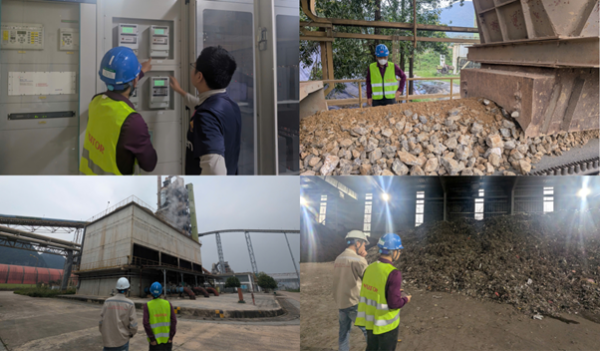
Photo: VNEEC team conducting field survey at the cement plant of Vietnam Construction Materials Joint Stock Company
With nearly 20 years of experience and more than 200 policy advisory assignments for ministries and international donors on GHG emission reduction and energy transition policies in Viet Nam and Southeast Asia, VNEEC was selected to provide technical support to the Department of Climate Change under the Ministry of Agriculture and Environment within the framework of the project “GHG Emissions Analysis for Key Industrial Sectors under Decision No. 13/2024/QD-TTg,” funded by the German Agency for International Cooperation (GIZ).
The technical support covered the preparation and implementation of surveys, data collection and processing, and data analysis to ensure that the results accurately reflected the actual emissions profiles and operational conditions of the facilities concerned. During the implementation, international experience and best practices from countries that have introduced emissions allowance allocation mechanisms were reviewed through discussions with international experts. Relevant ministries, industry associations, enterprises, and facilities were also engaged to ensure the approach was practical, objective, and suitable for the national context.
The project results provide an analytical basis to support the allocation of GHG emissions allowances by the Department of Climate Change under the Ministry of Agriculture and Environment.
1,730 views, 13
Tags:
Bài viết liên quan